
Low Voltage Surge Arrester for Power Systems --- Reliable, Safe,Fast
LV surge arrester adopts UL certified high-performance MOV as the core components, with high surge discharge capacity and low voltage protection level. It can effectively suppress the transient over voltage on power line caused by lightning strikes and other electrical source.
Key Features
- Ultra-fast response time (nanoseconds)
- Low residual voltage with stable protection
- Compliant with UL1449 4th, IEEE Std C62.11™
Applications
designed for the transformer low-voltage side protection at distribution transformer secondary bushings, against the risk of the harmfuleffects of transient surges, to ensure the smooth operation of transformer.

-
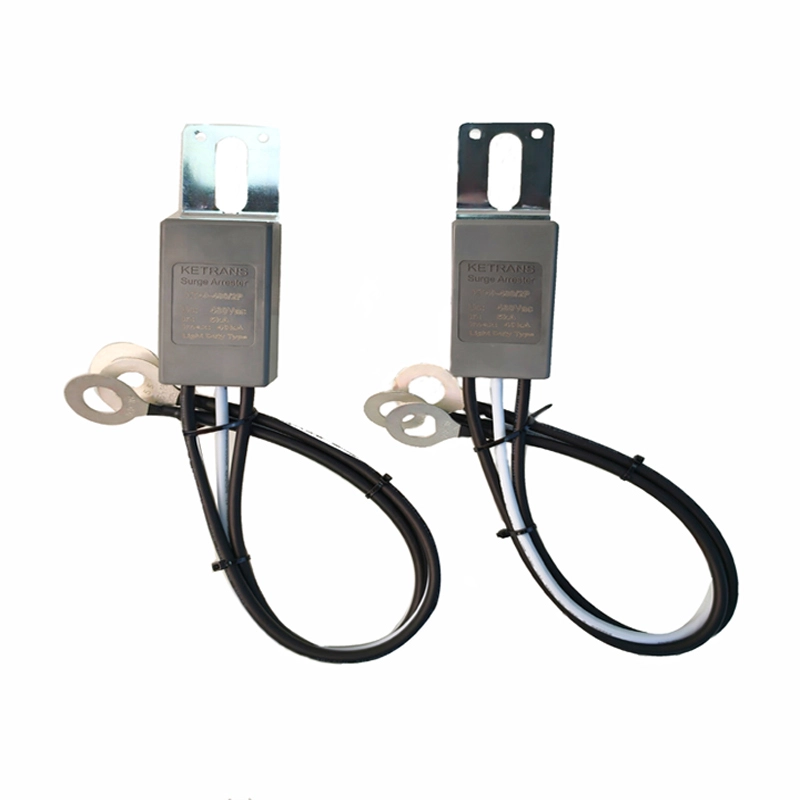 480V Single Phase LV Arrester
- Model No.: KT40-480V/2P
- Power System: 240/480V(split phase)
- MOCV: 550Vac
Learn More -
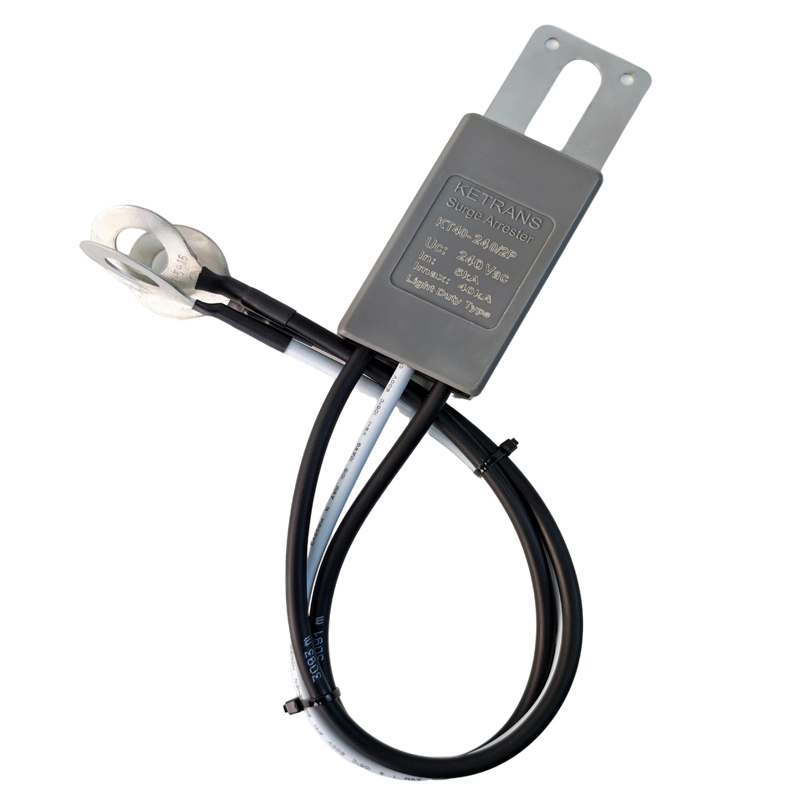 240V Single Phase LV Arrester
- Model No.: KT40-240/2P
- Power System: 120/240Vac(Split phase)
- MOCV: 420V(460V as option)
Learn More -
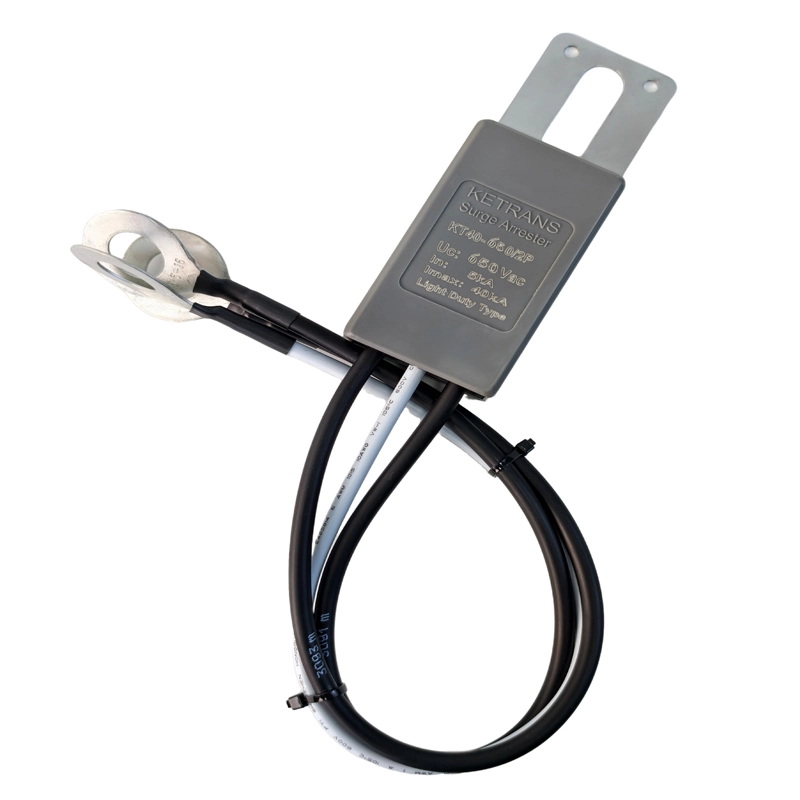 650V Single Phase LV Arrester
- Model No.: KT40-277/S
- Power System: 277Vac (single phase
- MOCV: 650 Vac
Learn More
Working Principle
These arresters use zinc oxide (ZnO) varistors that rapidly change resistance during surge events. When a surge occurs, the varistor conducts instantly, diverting excess current to ground and clamping the voltage to a safe level.
Installation and Precautions
- Install at the system inlet or distribution panel busbar.
- Ensure grounding resistance ≤10Ω and minimal wiring length.
- Coordinate with circuit breakers for full protection.
- Regularly inspect disconnector status and replace damaged units
Selection Guide
- Key parameters for selection include:
- rated voltage (Un),
- maximum continuous operating voltage (Uc),
- nominal discharge current (In),
- maximum discharge current (Imax),
- protection mode,
- environmental conditions.
Frequently Asked Questions
Q1: What are the grounding requirements when installing a single-phase low-voltage surge arrester?
A1: The grounding should be firm and reliable, and the grounding resistance is generally required to be no more than 4Ω. A ground wire with a sufficient cross-sectional area should be used, usually a copper core wire of not less than 6mm², and the ground wire should be as short and straight as possible to reduce grounding resistance and inductance.
Q2: How to test the leakage current of a single-phase low-voltage surge arrester?
A2: A portable leakage current analyzer can be used for measurement. Under normal circumstances, the leakage current should be below 1mA. If it exceeds 2mA, it may indicate that the surge arrester has a potential fault and needs further inspection or replacement.
Q3: What is the difference between the maximum continuous operating voltage (Uc) and the rated voltage?
A3: The rated voltage is the maximum effective voltage that the surge arrester can withstand for a long time, while the maximum continuous operating voltage (Uc) is the highest voltage at which the surge arrester can work continuously without exceeding this voltage. Uc is usually slightly higher than the rated voltage. For 480V systems, the Uc of surge arresters can generally be 510V or higher.